
Fort Hamilton History
Fort Hamilton was built in the late summer and fall of 1791 as a frontier supply depot for the United States Army, part of a chain of forts meant to move men, arms, and provisions north into the contested Ohio Country during the opening campaigns of what is now called the Northwest Indian War. Construction began on September 17, 1791, on the east bank of the Great Miami River, roughly twenty-five miles north of Fort Washington at Cincinnati, at a natural ford that made the site a logical crossing point for troops and pack trains. The fort was formally dedicated on September 30 that year and named for Alexander Hamilton, then serving as the nation’s first Secretary of the Treasury under President Washington. Its original stockade was a four-sided, four-bastioned structure typical of the period, built under the direct command of Major General Arthur St. Clair, who was leading roughly 2,000 men north that fall in an effort to strike decisively at the Native confederacy of the region.
That effort ended in catastrophe. On November 4, 1791, St. Clair’s army was overwhelmed near the headwaters of the Wabash River by a coalition of Native nations under the joint leadership of the Miami war chief Little Turtle and the Shawnee war chief Blue Jacket. More than 600 American soldiers were killed in what remains, proportionally, the worst defeat ever inflicted on the United States Army by Native American forces — a disaster still often referred to as St. Clair’s Defeat, or the Battle of the Wabash. Fort Hamilton, spared the battle itself, became instead a waypoint for the survivors streaming south, and later a staging ground for the grim expedition that recovered and buried the dead the following winter.
The defeat brought St. Clair’s military career to an end. Congress convened what became the first congressional investigation of an executive department in the nation’s history, and that inquiry — after reviewing the state of the army’s supply, arms, and provisions — placed the blame not on St. Clair’s generalship but on the War Department’s contracting failures: spoiled powder, unbroken and half-starved horses, and flour that arrived late, if it arrived at all. St. Clair was effectively exonerated of personal fault. He resigned his military commission in 1792, but he did not leave public life; he continued to serve as Governor of the Northwest Territory, a post he had held since 1788, and would remain in that office for another decade, until 1802.
In St. Clair’s place, command of the western army fell first to Brigadier General James Wilkinson, an ambitious and well-connected officer who had led the burial expedition to the Wabash battlefield. Wilkinson enlarged Fort Hamilton, ordering additions to the north side of the original stockade in 1792 to provide covered stabling for the army’s packhorses and space to repair its wagons — infrastructure the campaign had learned, at brutal cost, that it could not do without.
The following year brought the general most associated with the fort’s later years: Major General Anthony Wayne, called “Mad Anthony” for his aggressive reputation in the Revolution, who had been given command of the newly organized Legion of the United States, a professionally drilled force built to succeed where St. Clair’s had failed. In September 1793, Wayne marched the Legion from its training camp near Cincinnati to Fort Hamilton and ordered a further expansion of the works that summer, enlarging the post into the substantial fortified depot — complete with expanded stables for the Legion’s dragoons and additional barracks — that would anchor his advance north the following year.
A corrosive rivalry developed between Wayne and his own second-in-command, James Wilkinson. Passed over for the Legion’s top command and resentful of it, Wilkinson spent years working to undermine his superior — leaking criticism to newspapers and to Wayne’s political enemies in Congress, second-guessing his decisions in front of junior officers, and, unknown to Wayne at the time, secretly drawing a pension from the Spanish crown while passing intelligence on American troop movements to Spanish officials in New Orleans. Wayne pressed on regardless, and in August 1794 the Legion he had built broke the Native confederacy’s resistance decisively at the Battle of Fallen Timbers, near present-day Maumee, Ohio. Almost a year later, on August 3, 1795, Wayne negotiated the Treaty of Greenville, in which the assembled tribes ceded most of what is now Ohio to the United States.
With the frontier secured and the chain of forts no longer needed for active campaigning, Fort Hamilton was gradually dismantled in the years that followed, and the post was formally decommissioned in 1796. Only one structure endured beyond that point: the powder magazine, which had stood in the southern portion of the fort. It survived for well over a century after the rest of the stockade had vanished beneath the growing town of Hamilton, until it was finally swept away by the catastrophic Great Miami River flood of March 1913.
Today the site of the fort lies beneath the Soldiers, Sailors, and Pioneers Monument on South Monument Avenue, a memorial that stands fittingly on the ground where the American frontier first took hold in Butler County.
Contributed by: Richard O Jones
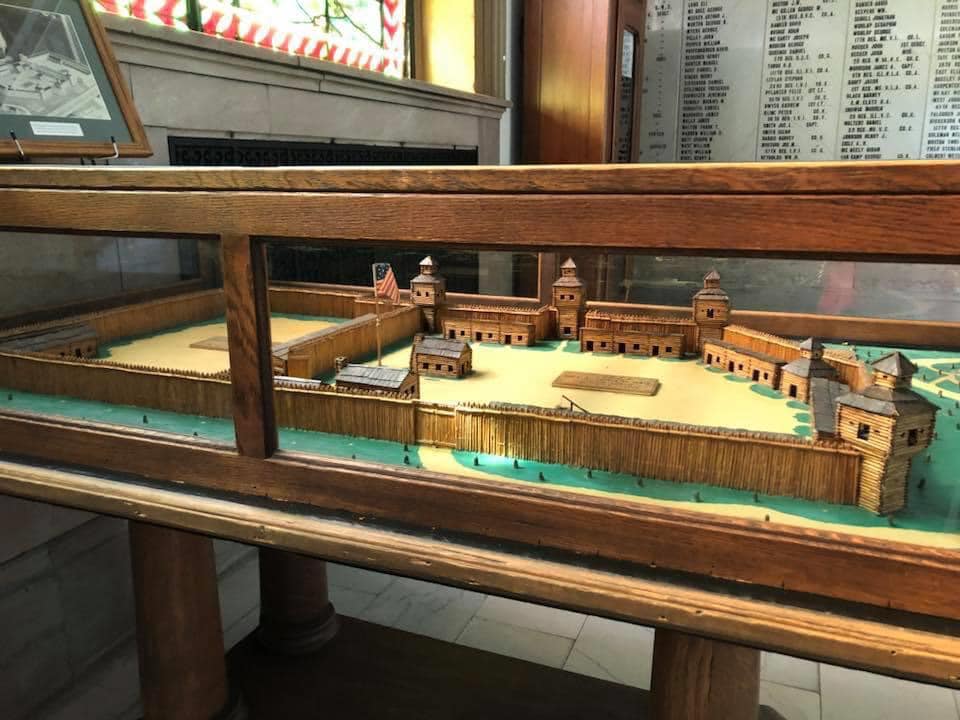
Spanish-American War veteran Walter McDonald, former monument curator, spent two years constructing this scale model, finishing it in 1939. Actual size shape of the original fort are not certain, but it may have been as large as 1 or 2 football fields. This model is on permanent display at the monument.